Self-healing display material
Sound waves can be used to keep an object hovering in the air, and a new technique works even in crowded spaces

Sound waves can be used to keep an object hovering in the air, and a new technique works even in crowded spaces
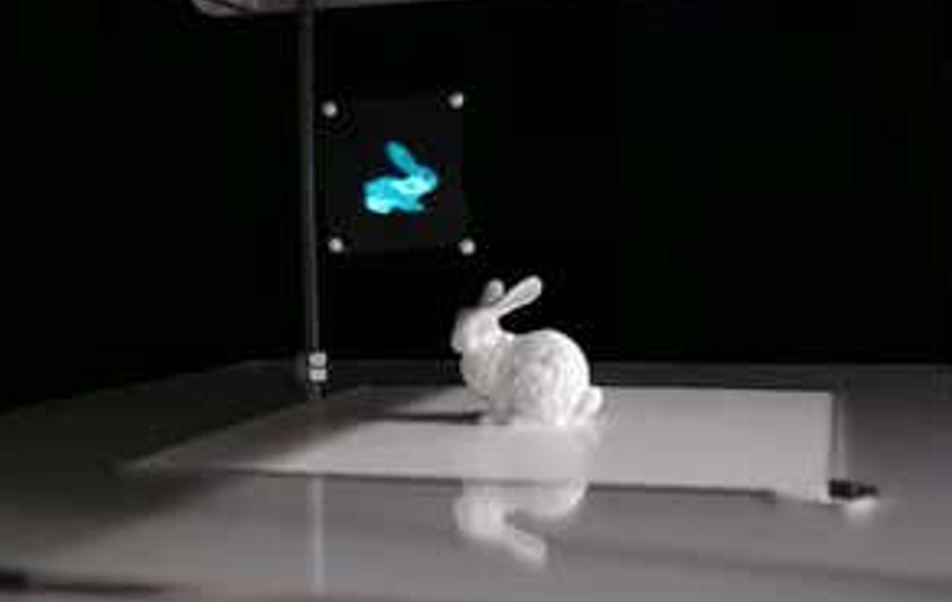
A rabbit hologram levitated above a 3D-printed rabbit
Ryuji Hirayama, University College London
Ultrasonic sound waves have been used to levitate objects in crowded rooms to make hologram-like displays, and such acoustic levitation was previously only practical in empty spaces. Still, a new algorithm can quickly readjust the sound waves when they encounter an obstacle to keep the object in the air.
Sound waves are comprised of air particles moving together. If manipulated correctly, they can pick up and move objects. However, if the sound waves run into another object that reflects or scatters them, the levitating object can tumble down.
Ryuji Hirayama at University College London and his colleagues used sound to levitate glowing beads to create floating 3D shapes. Now, they have developed a computational technique that enables them to levitate and manipulate objects above bumpy surfaces and near objects.
Hirayama and his colleagues used 256 small loudspeakers arranged in a grid to levitate objects with precisely shaped ultrasound waves. When these sound waves encountered objects that would usually scatter them, like a wall or a houseplant, a computer algorithm quickly adjusted their shape to maintain levitation.
The researchers demonstrated their technique by 3D printing a small plastic rabbit, then levitating objects near it. In one experiment, they made illuminated beads fly around the rabbit in the shape of a butterfly whose “wings” could be controlled by the motion of a researcher’s fingers.
Sound holograms

In another, they levitated a piece of nearly transparent fabric above the rabbit and made it spin while a projector cast images of the rabbit onto it. The result was a seemingly 3D rabbit hologram hovering above its plastic counterpart.
They also levitated a drop of paint over a glass of water. This experiment showed that their algorithm works even when suspending objects that can change shape above a surface that can wiggle as it reflects sound.
Bruce Drinkwater at the University of Bristol in the UK says that the new technique could project information with lots of “wow factor” in museum displays or advertising. It could also be employed in chemical engineering, using sound waves to mix materials without anyone having to touch them. He says that the new method seems more robust than previous ones, so it could make acoustic levitation practical more broadly.
We want to make this technology practical and have it react to objects in real-time.
he says
Hirayama says that, so far, he and his colleagues have only considered acoustic levitation in spaces full of sound-scattering objects that don’t move at all or move only in a few predictable ways, such as a hand trying to touch a levitating hologram. Their next goal is to perfect their mid-air object manipulation using sound everything in the room moves in unexpected and unanticipated ways.
Part 3 – Identifying Inventive Principles – Presentation
David Conley received his BS of Nuclear Engineering from Texas A&M University and his Masters of Finance from the University of New Mexico. As an Air Force Officer he performed plasma physics and space nuclear propulsion research and served at Los Alamos and Brookhaven National Laboratories and on NASA’s Nuclear Safety Review Panel. His private sector experience includes Johnson and Johnson, Philips Semiconductor, and Intel Corporation. At Intel Corp. from 1995 until 2012 David held a variety of engineering and management roles and is the only person corporate wide to have ever held a Level 4 Specialist certification in the science of innovation – TRIZ. During his last five years at Intel he oversaw the organization’s worldwide innovation program steering committee and was responsible for direction setting, training development and proliferation of innovation methods within Intel.
Read more onnewscientist.com